According to a joint announcement by the U.S. Department of Homeland Security and the State Department, this policy categorizes the 19 countries into two restriction tiers with clearly defined targets.
Citizens of the following 12 countries will see nearly all types of immigrant and nonimmigrant visas suspended (with rare exceptions for diplomatic purposes):
Asia/Middle East: Afghanistan, Iran, Yemen, Myanmar.
Africa: Chad, Republic of the Congo, Equatorial Guinea, Eritrea, Libya, Somalia, Sudan.
Caribbean: Haiti.
The White House spokesperson explained that these countries have been deemed "ineligible for U.S. entry security standards" due to either political instability preventing accurate citizen background verification or refusal to cooperate in repatriating their citizens deported from the United States.
For the following 7 countries, the U.S. will primarily suspend tourist, business, and certain specific work visas while significantly tightening immigration visa approval quotas:
Latin America: Cuba, Venezuela.
Africa: Burundi, Sierra Leone, Togo.
Asia/Central Asia: Laos, Turkmenistan.
U.S. embassies and consulates in these countries have suspended routine visa services. The State Department advises citizens of affected nations to closely monitor official guidance.
The severity of this policy lies in its ripple effects across different groups, with impacts far exceeding previous measures.
I. International Students and Exchange Visitors: Pathways to Education Blocked
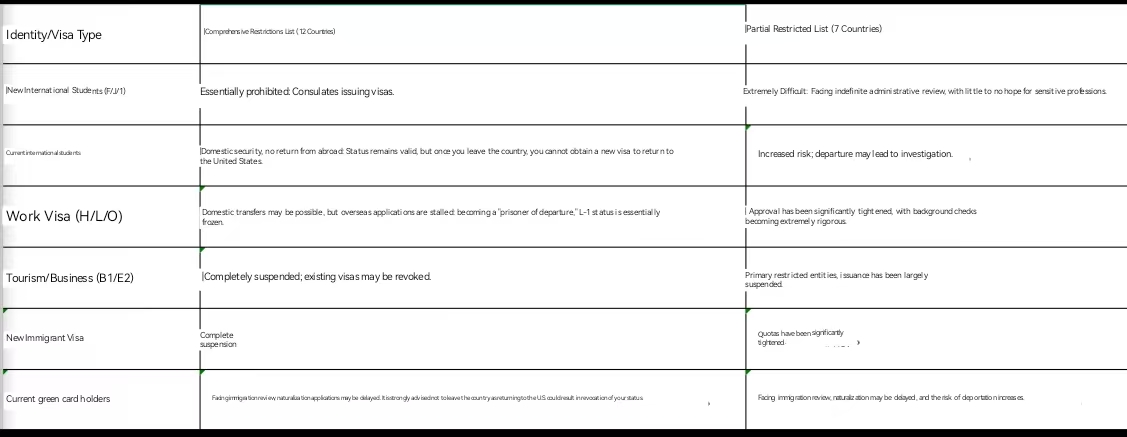
12 Countries on Comprehensive Restriction List: New students are effectively barred from obtaining F-1, J-1, and similar visas. Current students in the U.S. retain legal status for now but are strongly advised not to leave the country. Departure would prevent them from obtaining new visas to return, potentially halting their studies.
Partial Restriction List (7 Countries): Student visa applications will be mired in "administrative review," potentially facing indefinite processing delays that prevent timely enrollment. Students in sensitive fields like STEM face near-certain visa denials.
II. Work Visa Holders: Career Dreams Turned "Prisoner's Dilemma"
H-1B, L-1 Professionals: Even those who successfully changed status within the U.S. become "prisoners unable to leave." Departure would halt or deny visa stamping at overseas embassies/consulates. L-1 visa issuance has largely stalled due to cross-border business background checks.
O-1 Visa for Individuals with Extraordinary Ability: This remains the sole, yet extremely high-barrier pathway. Applicants must demonstrate "extraordinary and irreplaceable" contributions to U.S. national interests, with approval standards significantly heightened.
III. Tourist and Business Visas: Pathways Completely Closed
For citizens of these 19 countries, B-1/B-2 visas were the first channels severed. Even previously issued, valid 10-year visas may be revoked on-site by Customs and Border Protection (CBP) upon entry, resulting in immediate deportation.
IV. Existing Green Card Holders: Permanent Status No Longer "Permanent"
This is the most striking aspect of the policy, signifying retroactive scrutiny.
Naturalization Applications Paused: Naturalization applications submitted by green card holders from these 19 countries will be suspended pending deeper background investigations.
Travel becomes high-risk: While green card holders are not explicitly barred from leaving the U.S., they are strongly advised against doing so. Those absent for over six months will face extremely rigorous secondary inspections upon return, where border officials may question their intent to reside in the U.S. and even initiate procedures to revoke their green cards.
Retroactive Identity Reviews: U.S. Citizenship and Immigration Services (USCIS) will initiate background re-examinations of approved green cards. If original applications are found to contain concealed information, or if the applicant's home country government fails to cooperate in providing identity verification records, permanent residency status may be retroactively revoked.
The policy immediately sparked intense controversy upon release. Supporters argue it is a necessary measure to safeguard national security and improve identity verification mechanisms. Opponents, including multiple human rights organizations, condemn the policy as overtly discriminatory based on geography and ethnicity, warning it will create a massive humanitarian crisis and tear apart countless families.
This measure is also seen as the concrete implementation of the administration's earlier public statements regarding the suspension of immigration from "third world countries." It is expected to trigger ongoing legal challenges and diplomatic turmoil both within the United States and internationally.

Email: info@sinoamericanrec.org
Tel: +1(626)-658-6066
Office Address(Expect):Los Angeles county

Follow to our WeChat or leave a message in the form.
SAREC is a high-end cross-border platform that connects real estate developers, investment elites, fund managers, financial institutions and professional service providers in China and the United States.
Email: info@sinoamericanrec.org
Tel: +1(626)-658-6066
Office Address:Los Angeles county

If you have a project or collaboration that you would like to discuss with us, or if you would like to know what solutions we can provide for you, we look forward to your consultation.
Contact Tel
Follow to our WeChat or leave a message in the form.
 English


